

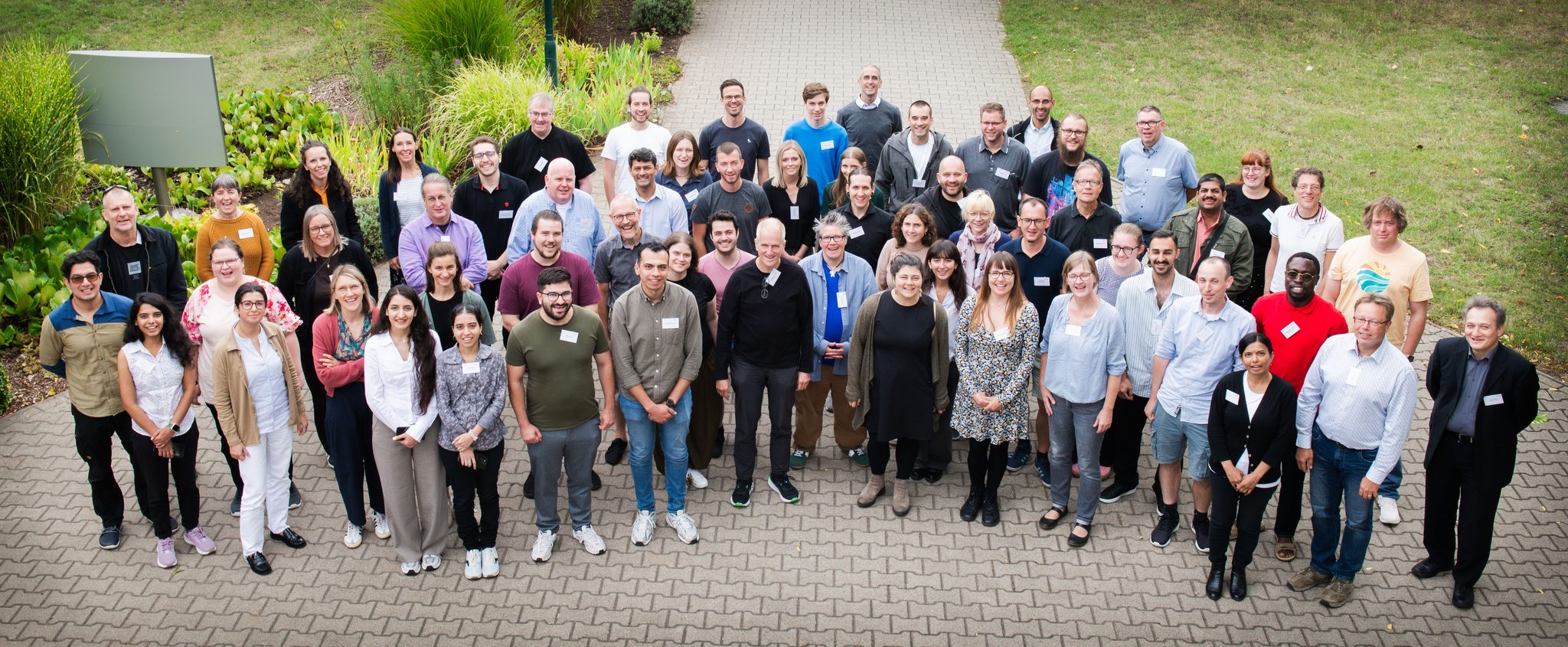
 Around 70 bioinformaticians and research data management experts met at Leibniz Institute of Plant Genetics and Crop Plant Research (IPK) in Gatersleben from 2 to 4 September 2026. Much of the work they presented builds on services and infrastructure from de.NBI / ELIXIR Germany.
How can heterogeneous life science data be prepared so that tools, workflows and AI methods can actually use it? That question ran through nfdi4LS-IB2026 at the Leibniz Institute of Plant Genetics and Crop Plant Research (IPK) in Gatersleben. The meeting was the first NFDI4LifeSciences Conference and, at the same time, the 20th International Symposium on Integrative Bioinformatics, a series carried by IMBio e.V. since 2003. It was organised by the NFDI consortia DataPLANT, FAIRagro and NFDI4Biodiversity, with support from NFDI4Microbiota, NFDI4BIOIMAGE and NFDI4Objects. Together, these six consortia form the NFDI Biodata Interest Group. The conference was funded by de.NBI (ELIXIR Germany) and the German Research Foundation (DFG).
IPK was a natural host: it is a partner in the de.NBI service unit German Crop BioGreenformatics Network (GCBN), which is coordinated by Uwe Scholz (IPK), and co-applicant in all three organising consortia. Participants came from six countries and ranged from bioinformaticians and data scientists to data stewards and research software engineers.
Programme: seven keynotes, 23 talks, 19 posters
From 45 submissions, the programme committee put together seven keynotes, 23 talks and 19 posters. The keynotes covered a wide range. Micky Lindlar (TIB Hannover) showed that investment in long-term preservation pays off in the short term. Stephanie Jurburg (UFZ Leipzig) presented MiCoDa, a curated collection of 30,000 uniformly processed microbiome samples, and the Datathons through which she trains researchers worldwide in metadata practice. Doreen Ware (Cold Spring Harbor Laboratory and USDA), joining by video, described how plant genomics resources such as Gramene and SorghumBase can be made ready for AI without losing the link to the underlying biology. Can Türker (Functional Genomics Center Zurich) spoke about bringing instruments, data and operations together in a core facility, and Paul Shaw (James Hutton Institute) about information systems for plant genetic resources. Sabina Leonelli (Technical University of Munich) looked at biodata from the perspective of the philosophy of science, and Keywan Hassani-Pak (Rothamsted Research) closed the conference by asking whether knowledge graphs and AI agents can generate new hypotheses together.
Where de.NBI / ELIXIR Germany showed up
A notable number of contributions rely on de.NBI services and structures. Some examples:
- de.NBI Cloud as compute backbone: The Type (Strain) Genome Server (TYGS) from Leibniz DSMZ now uses the de.NBI Cloud for scalable, fail-safe computation. FAIRagro runs its own REANA instance there, on which workflows built with the SciWIn tool are executed reproducibly.
- ISA Wizard: Manuel Feser (IPK) showed how the de.NBI / ELIXIR-DE service ISA Wizard harmonises metadata collection across domains. A configuration for animal studies came out of an ELIXIR BioHackathon project, and the new livestock metadata standard MIMSA is set to be captured with the ISA Wizard as well.
- e!DAL-PGP: A poster presented the development of the de.NBI service e!DAL-PGP into a FAIR, interoperable and AI-ready submission platform for plant research data, a joint effort of de.NBI, DataPLANT, FAIRagro and NFDI4Biodiversity.
- Quality management: NFDI4Biodiversity's quality management framework for its services draws, among other sources, on the de.NBI / ELIXIR-DE guidelines for node service selection and quality management.
- Training: Another poster described the collaboration between FAIRagro and de.NBI / ELIXIR-DE on research data management training, from joint courses to train-the-trainer approaches.
Taken together, these examples show that de.NBI's bioinformatics infrastructure and the NFDI's research data services are no longer developed side by side but increasingly build on each other, thereby allowing synergies to be exploited.
Early career researchers, poster award and social programme
To give early career researchers visibility, posters were introduced in three pitch rounds in the plenary. The poster award, voted by the participants, went to Sarah Büker (University of Bremen) for "What Is Your Favourite Bird? Using Biodiversity Data to Teach Data Literacy Across Disciplines". She showed how bird observation data make it easier to introduce topics such as the FAIR principles, metadata standards and the handling of sensitive data.
Alongside the scientific programme, participants could join guided tours of the IPK PhenoSphere and genebank, a walking tour of the UNESCO World Heritage town of Quedlinburg and the conference dinner. Nine selected contributions will be published in a special issue "IB-2026" of the Journal of Integrative Bioinformatics.
More information
Conference website: meetings.ipk-gatersleben.de/nfdi4LS-IB2026
Digital abstract book: ipk-bit.github.io/ib2026-abstract-book
Photos: meetings.ipk-gatersleben.de/nfdi4LS-IB2026/gallery
Biodata Interest Group, Memorandum of Understanding: doi.org/10.5281/zenodo.18694155
Text: Mary-Ann Ebeling, Leibniz Institute of Plant Genetics and Crop Plant Research (IPK) in Gatersleben